Want

Then he sat down, called the Twelve, and said to them,
“If anyone wishes to be first,
he shall be the last of all and the servant of all.”
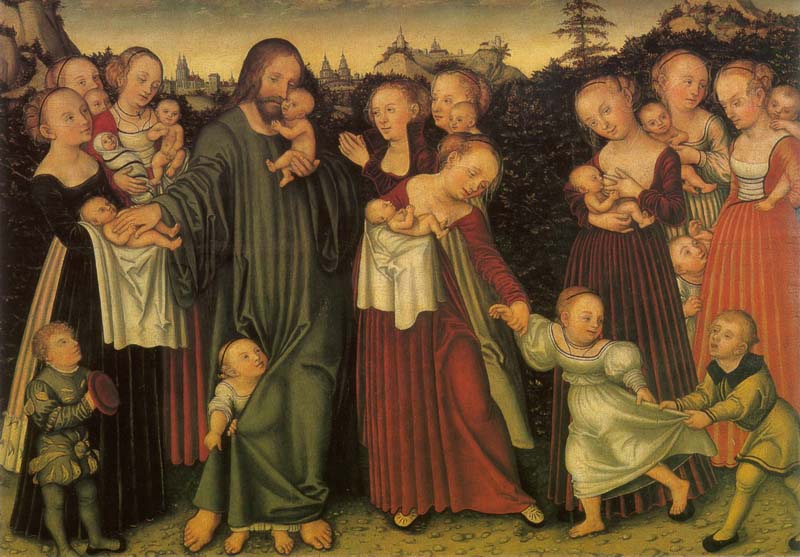
Taking a child, he placed it in their midst,
and putting his arms around it, he said to them,
“Whoever receives one child such as this in my name, receives me;
and whoever receives me,
receives not me but the One who sent me.”
Mark 9:30-37

I want to serve you, Lord my God,
to do what you command,
to rule the world with staff and rod,
to sit at your right hand.
But you ask me to be the least
while others' needs are filled,
to serve your children at your feast,
when I am hungry still.

I want to follow you, O Lord,
forever chase your light
to trace your steps down every road
and with you climb the heights.
But you go towards Jerusalem;
you know that way is death.
How can I take the road again
beyond my final breath?

I want to love you, O my Christ,
and love without regret,
to look at last into your eyes
and find myself in them.
My downward road lift up on high;
my crooked ways make straight,
that when your death becomes my life,
my life becomes your praise.

Christ blessing the Children by Lucas Cranach the Youngerhttp://www.botschaftderwoche.de/pics/bild061008.jpg, Public Domain, https://commons.wikimedia.org/w/index.php?curid=22737097

Matthew, the Tax Collector

As Jesus passed by,
he saw a man named Matthew sitting at the customs post.
He said to him, “Follow me.”
And he got up and followed him.
While he was at table in his house,
many tax collectors and sinners came
and sat with Jesus and his disciples.
The Pharisees saw this and said to his disciples,
“Why does your teacher eat with tax collectors and sinners?”
He heard this and said,
“Those who are well do not need a physician, but the sick do.
Go and learn the meaning of the words,
I desire mercy, not sacrifice.
I did not come to call the righteous but sinners.”

Matthew 9:9-13

What could the prophet want of me?
I speak with Caesar's voice
and eat my meals with hands unclean
from counting out his coins.
But Jesus passed me at my post,
and that was all he said—
just “Follow me,” and I was lost,
and now he shares my bread.

The holy men who spit at me
are gathered at my door
to sneer and crane their necks to see
and judge the wine I pour,
but he has thanked me for the wine
and he has blessed my bread,
and for perhaps the only time
I finally am fed.

I wept to hear his voice in prayer—
I was forgiven then,
and I would follow anywhere
to taste this joy again.
So let the righteous turn away;
they have their sacrifice.
We who have eaten well today
have seen and known the Christ.

The Calling of Saint Matthew, 1599–1600, Caravaggio By Caravaggio – Self-scanned, Public Domain, https://commons.wikimedia.org/w/index.php?curid=15219497

Apple

“Do you see this woman?
When I entered your house, you did not give me water for my feet,
but she has bathed them with her tears
and wiped them with her hair.
You did not give me a kiss,
but she has not ceased kissing my feet since the time I entered.
You did not anoint my head with oil,
but she anointed my feet with ointment.
So I tell you, her many sins have been forgiven;
hence, she has shown great love.
But the one to whom little is forgiven, loves little.”
Luke 7:36-50

The righteous men refused to eat the apple—
their eyes were never opened to their sin.
They never got down in the mud to grapple
with all the filth that comes out from within.

But she has tasted, and she knows its flavor:
The skin was red and firm beneath her touch,
and it was sweet—the sweetest—so she savored,
and well she knows she is forgiven much.

Then why should she withhold the alabaster?
No, let her perfumed prayer like incense rise,
and let them stare, though none will dare to ask her
what is it draws this torrent from her eyes?

They sit at feast, yet they have tasted nothing
except their scorn to see her at his feet,
but she is sated with her Lord's anointing,
for here is something more than apples sweet

and only they who taste and they who hunger
will one day know the pleasure of that feast,
when he who came to seek them in the mud here
bows down himself to wash their dirty feet.

The Ointment of the Magdalene (Le parfum de Madeleine). James Tissot, c. 1900 – Online Collection of Brooklyn Museum; Photo: Brooklyn Museum, 2007, 00.159.214_PS2.jpg, Public Domain, https://commons.wikimedia.org/w/index.php?curid=10957535