First the Blade

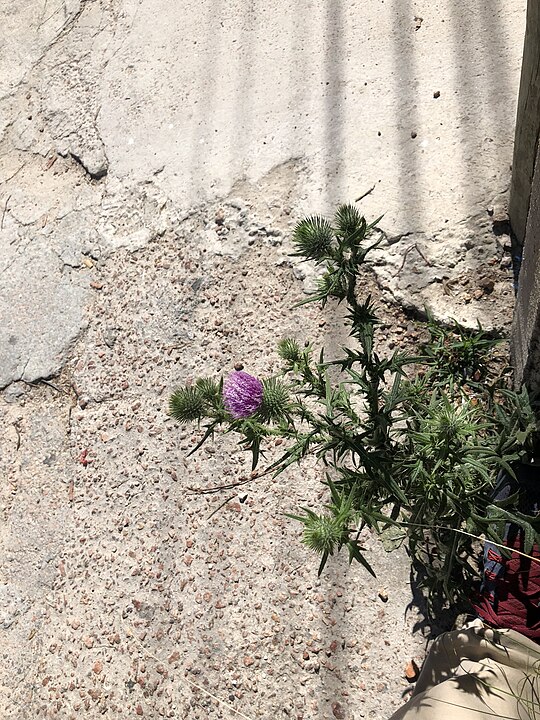
He said, “This is how it is with the kingdom of God; it is as if a man were to scatter seed on the land and would sleep and rise night and day and the seed would sprout and grow, he knows not how. Of its own accord the land yields fruit, first the blade, then the ear, then the full grain in the ear. And when the grain is ripe, he wields the sickle at once, for the harvest has come.”

Mark 4:26-29
First the harrow, then the plow
turns and opens barren fields
where the seeds are trampled down
into wounds the sun will heal.

First the shoot and then the leaf
pierce the earth to catch the rain,
turning all this dead world green,
springing up to life again.

First the sprouting, then the growth
prophesying joy to come,
bounty pledging summer's troth
while the length'ning days run on.

First the blade and then the ear,
then the grain comes, rip'ning gold,
to the harvest of the year,
to the feast so long foretold.

First creation's sixfold day,
then the years' repeating rounds:
Death and life eachother chase
'til the final sun goes down,

then out of the ling'ring gloom
comes the day that will not end.
Seeds sprout up from every tomb.
Winter will not come again.

By User:Bluemoose – Own work, CC BY-SA 3.0, https://commons.wikimedia.org/w/index.php?curid=333105

The Word

In the beginning was the Word,
long before worlds began.
After the end it shall be heard,
spoken aloud again!

Spoken at first, it silent fell
under the reign of death,
now does it ring out as a bell,
sung on undying breath.

What is the word that shapes our sense,
filling the skies above,
echoing in the caverns' depths?
What could it be but love?

What was the silence of the grave
stilling the Word at last?
What could it be but love that gave,
filling death's endless grasp?

Stronger than death is that great love,
deeper than any hell,
truer than stories tell us of,
broader than ocean swells.

Into the silence now it speaks,
thunder with lightning's flame,
filling forever's depths and peaks,
calling us each by name!

Three Marys, by Henry Ossawa Tanner. From the left, Mary Magdalene, Mary the mother of James, and Salome approaching Jesus’ tomb. Oil on canvas, 42 × 50 in. Fisk University Art Galleries, Nashville, Tennessee. By Henry Ossawa Tanner – https://artandtheology.org/tag/henry-ossawa-tanner/, Public Domain, https://commons.wikimedia.org/w/index.php?curid=132778182

Harrowed

To lie so long in darkness
that you forget your sight—
then shaken by a heartbeat,
pierced by a spear of light,
your chest, constricted, burning—
you choke through yards of dirt.
The breath of life returning,
and oh, dear God, it hurts.

Contort and cough and retch now;
remember how to gasp.
Your folded hands are stretched out
and pinned within his grasp.
Your legs are drawn and trembling,
weak as newborn pup,
the fragments reassembling
as you are lifted up.

How many days you lay there,
crumbling at last to dust!
Now all at once awakened,
ravenous, drenched in thirst,
still your son draws you upward,
Adam and Mother Eve,
to where he fills the cup full.
Take it, he says, and drink.

In Harrowing of Hades, fresco in the parecclesion of the Chora ChurchIstanbul, c. 1315, raising Adam and Eve is depicted as part of the Resurrection icon, as it always is in the East. Photo By © José Luiz Bernardes Ribeiro, CC BY-SA 3.0, https://commons.wikimedia.org/w/index.php?curid=16873002

Valley

They shall live on the land that I gave to my servant Jacob,
the land where their fathers lived;
they shall live on it forever,
they, and their children, and their children’s children,
with my servant David their prince forever.
I will make with them a covenant of peace;
it shall be an everlasting covenant with them,
and I will multiply them, and put my sanctuary among them forever.

Ezekiel 37:21-28
And yea, though we must walk the valley here—
the road runs through the shadow of our death—
we shall not linger in the vale of tears,
but go to where the Shepherd gives us rest:

a homeland where the harvest never fails;
a city where the gates are open wide,
where peace lets out at last a long exhale;
a living spring that never will run dry;

where there are no more wars, no sword that falls;
no mothers weep to kiss their sons goodbye;
where no one trembles when the trumpet calls.
It says, The feast begins! Come all inside!

For he has laid a table in our sight,
and there beside our foes we take our seats
where all our cups run over with new wine
and Christ himself breaks bread, that we may eat.

When shall we see the breaking of that dawn?
O, pierce the shadows! Let us see the road.
We follow in the way all flesh has gone—
But lead us on, beyond where death can go.

Make straight the way, though all our steps may fail.
In darkness still, we shall not wander blind,
for we shall be your pilgrims in the vale:
Leave love and mercy there for us to find.

The Old Tower in the Fields (1884) By Vincent van Gogh – Christie’s, LotFinder: entry 5790823 (sale 2846, lot 267, New York, 7 May 2014), Public Domain, https://commons.wikimedia.org/w/index.php?curid=32286355

Exodus

You come now to the strand:
The sea before you crawls,
and though you cling to your homeland,
another kingdom calls.

Your feet, already wet,
inch toward the farther shore.
You are a creature of the depths
you've never known before.

You try to dig right in,
to grip the gritty sand,
but each wave slipping back again
pulls home out of your hands.

Let go; O love, let go.
This Egypt is not yours.
You stand now on the Red Sea road,
with only one way forward:

through sorrow and through pain.
They will not stand like walls,
but plunge you in the heaving main.
You cannot swim at all.

They only promise this,
that whispers in the tide:
Beyond the sea, beyond abyss,
there is another side.

Crossing of the Red Sea By Nicolas Poussin – http://www.1st-art-gallery.com/Nicolas-Poussin/The-Crossing-Of-The-Red-Sea,-C.1634.html, Public Domain, https://commons.wikimedia.org/w/index.php?curid=10289613

The 14th Station: Entombment

We adore you, O Christ, and we bless you,
because by your holy cross, you have redeemed the world.

Oh, but it was always thus:
Ash to ashes, dust to dust.
Wisdom knows our little day;
all who're born return to clay.

So it is since Adam's fall:
foul or guiltless, mortal all.
Ours the cross, the grave, the cold,
so you came, our death to hold.

When they laid you in the tomb,
what the light could pierce that gloom?
That's the shadow where we dwell:
Every grave our prison cell.

How could any dawn break through,
any glimmer less than you?
You alone could tear that veil,
so you did, by blood and nail.

Now you lie in Adam's grave,
chasing him you came to save
downward to the gates of hell,
mortal, like him, cold and still.

O you gates, lift up your heads.
Let him in, firstfruits of death.
He will take us from you, all.
Hail the day that saw him fall!

Holy God, Holy Mighty One, Holy Immortal One,
have mercy on us.

By Carl Bloch – http://www.1st-art-gallery.com/Carl-Heinrich-Bloch/The-Burial-Of-Christ.html, Public Domain, https://commons.wikimedia.org/w/index.php?curid=7984697

Mother

From Grace Hamman’s Jesus Through Medieval Eyes, the chapter on Christ as Mother. For Holy Week:

As Eve cried out in labor,
who bore the curse and Cain,
and wept again for Abel,
so you bear us in pain.

The body gaping open,
the wound of our first sin,
brings healing through the broken—
and new life enters in.

You walked the earth our brother,
formed with us of the dirt.
Now on the cross as mother,
your labor gives us birth

of water and the Spirit,
of holiness and blood.
The sin that we inherit
is drowned out in your flood.

Your body is out birthplace;
your sorrow is our hope.
O firstfruits of our dead race,
your life becomes our hope.

Your wounds O Lord, our shelter:
the shadow of your wings.
The cleft rock is our refuge,
O mother of all things!

The Birth of Ecclesiafol. 2v (detail), ONB Han. Cod. 2554, Österreichische Nationalbibliothek, Vienna. Made in Paris, 1225–49.

Have Mercy

Have mercy on the flock,
though from your hand they flee.
If there's no mercy for the lost,
then there is none for me.

On all who cannot seek
beyond the bars they see:
If there's no mercy for the weak,
then there is none for me.

And on all who have done
what they dare not reveal:
If there's no mercy for the wrong,
then there is none for me.

On all who will fall down,
tripped on what they can't see:
If there's no mercy for the proud,
then there is none for me.

Have mercy on us all,
far-fallen though we be.
If there's no grace for those who call,
there can be none for me.

O God, have mercy still—
this, my unending plea.
Let even Judas' hands be filled:
Have mercy, Lord, on me.

The Kiss of Judas by Giotto di Bondone (between 1304 and 1306) depicts Judas’ identifying kiss in the Garden of Gethsemane

Spy Wednesday

What will you give me for him,
this troubling, trusting man?
Your soldiers cower before him;
I have him by the hand.

But still my hands are empty,
though thousands he has fed.
The world was mine: I left it—
for morsels of his bread.

He leads, and I have followed—
to hunger and to thirst.
His promises are hollow
as broken shells in the dust.

We cry to him for saving,
for healing, for the poor—
Whole armies fell to David;
he's turning tables over.

He calls himself a shepherd
who seeks the scattered sheep.
Then I must be too well fettered;
he does not look for me.

Then let him taste how bitter
it is to be his lamb.
So say what you will give me
to put him in your hands.

Christ tells his mother of what is to come; Judas on his way to the chief priest; Judas bargaining with the chief priests and receiving his silver By Unknown author – This image is available from the National Library of WalesYou can view this image in its original context on the NLW Catalogue, CC0, https://commons.wikimedia.org/w/index.php?curid=44920323

The 13th Station: Deposition

We adore you, O Christ, and we bless you,
because by your holy cross, you have redeemed the world.

Empty, the body, now,
gone beyond any harm.
Gently we lay him down,
safe in his mother's arms.

Now we are left behind,
we who would follow him.
Now we are deaf and blind,
lamed in our every limb.

Once we had seen his light
marking the way like stars,
breaking out from on high—
Now we dwell in the dark.

Gone is the mother hen:
No more beneath her wing
we flee the hawk again.
Vultures are circling.

Wash all the blood away,
soft as he laved our feet.
Care for his dust and clay,
now his care is complete.

Carry him, linen-bound,
spices tucked in the folds;
take him up in his shroud.
One last time, him we hold.

Holy God, Holy Mighty One, Holy Immortal One,
have mercy on us.

Rembrandt. The Descent from the Cross. 1633.