Rend Your Hearts

Year after year my heart I've rent;
day after day again.
Relent, O God! Will you relent?
I wither until then.

How can this heart of stone still feel?
For look: It bleeds like flesh.
Can you restore? Can you yet heal
what rushes on toward death?

But if you can, then heal my heart,
you who have seen its wounds.
Make me unstained as at my start,
who make the lepers new.

Wash me with hyssop, purging me;
pour rivers through my soul.
If you will cleanse me, I am clean—
Let Jordan's waters roll.

And when in silence I am come,
finding that farther shore,
finish the work you have begun.
Bring stone to life once more!

For now I make my whispered plea
amid the dust and noise:
Renew the heart that beats in me!
Give back salvation's joys!

Auchencar standing stone with farm in background By © User:Colin / Wikimedia Commons, CC BY-SA 3.0, https://commons.wikimedia.org/w/index.php?curid=26698896

Ash Wednesday

Now is the desert yawning

where you have led our steps;
now is the dim-lit dawning
showing the days far-spent.

Oh, could I tear my garments,
could some repentance show!
How can I rend what's hardened?
How can I mend this stone?

Teach me to count the moments,
each one a fading breath:
Finite I then shall know them,
reckon the days 'til death.

Visit me, Lord, in secret.
Though my left hand is blind,
all of my sins, you see them:
See where I would go right.

Teach me to know me guilty;
show me my hidden schemes.
Wash me then with your hyssop;
clease me, and I am clean.

Bring me through fire and water,
long though the road may be.
Make us a way, O Father:
Make all our stone hearts beat.


More details

Ash Wednesday by Carl Spitzweg: the end of Carnival

By Carl Spitzweg – The Yorck Project (2002) 10.000 Meisterwerke der Malerei (DVD-ROM), distributed by DIRECTMEDIA Publishing GmbH. ISBN: 3936122202., Public Domain, https://commons.wikimedia.org/w/index.php?curid=159077

Feast

Christ, who made creation's harvest,

formed the riches of the seas,
take the little we have brought you:
Give it for the least of these.

Let our bread become a banquet,
loaves and fish a lordly feast
filling us with more than fragments:
Every hunger is relieved.

Look upon us with compassion
in our daily need for bread.
Crumbs would give us satusfaction,
yet you set a feast instead:

Goodly measures, packed together,
shaken down and running o'er,
every morsel mercy's treasure
dropping from your hand, O Lord.

Not to us or to our labors,
but to your abundance, thanks.
Now for us and for our neighbors,
take our off'rings in your hands.

Not to us you give your blessing,
but to all who hunger sore,
filling every hand that's empty,
overflowing more and more.

Milagre da “Multiplicação dos pães e peixes” (Mateus 14:13-21; Marcos 6:31-34; Lucas 9:10-17; João 6:5-15). Photo By © José Luiz Bernardes Ribeiro, CC BY-SA 3.0, https://commons.wikimedia.org/w/index.php?curid=16833907

Unclean

A leper came to Jesus and kneeling down begged him and said,
“If you wish, you can make me clean.”
Moved with pity, he stretched out his hand, 
touched him, and said to him, 
“I do will it. Be made clean.”
The leprosy left him immediately, and he was made clean.

Mark 1:40-45

To the tune FINLANDIA:

Look down, O God, on all befouled and cast off,

on all who slink and strive to go unseen,
on all who pass in shadows and through backdoors,
on all who hide and know themselves unclean.
Look down and see, who knows what I would ask for,
yet if you wish it, you can make me clean.

You know my need, who bore it in your body,
and my desire, much as I might deny:
I would be seen, but who would see me worthy?
I would be known; from being known, I fly.
I would be loved, but, Lord, I am not lovely.
O Son of David, do not pass me by!

But if you will, O Christ, if you desire it,
then you can heal this wounded, wayward heart.
Though hidden deep, yet you can seek and find it
and bring it home, though I would dwell apart.
Though strong its chains, yet you can still unbind it
and make it whole, though I have only shards.

O tender Lord and shepherd of the broken,
who searches out the lost in every land,
you call my name—I cannot hear it spoken;
then reach for me with healing in your hands.
Now spit in dust, and bid me to be opened,
and touch my tongue to sing your praise again.
Niels Larsen Stevns: Helbredelsen af den spedalske,Healing of the Leper – Own work (Own photo)(Skovgaard Museum, Viborg, Denmark), Public Domain, https://commons.wikimedia.org/w/index.php?curid=1430117 OLYMPUS DIGITAL CAMERA

Broken Cisterns 2

A re-write of this:

We set out for our Edens;

we thought we knew the way,
but shimmers in the distance
have tempted us to stray.
Still, Lord, we were insistent
that you would bless our days:
We dug these broken cisterns,
then knelt and prayed for rain.

You opened up the heavens,
poured water through our hands,
but all that we collected
ran off into the sands.
We thought that you would bless us
and sanctify our plans,
but, God, our wells are empty,
and thirsty still we stand.

But you know well the desert--
through forty days and nights
you let yourself be tempted.
You know our tears and sighs.
And you have felt our yearnings,
our hungers and our drives--
then may we feel your mercy.
O Mercy, hear our cry!

Take all our broken cisterns
and make them sound and whole.
Our locust-eaten vistas
in you can be restored.
Our empty wells transfigure;
redeem our hungry souls
to hold the good you've given:
Pour out your grace once more!

Broken Cisterns

Two evils my people have done:
they have forsaken me, the source of living waters;
They have dug themselves cisterns,
broken cisterns that cannot hold water.

Jeremiah 2:13
We walked the desert distance

in search of welcome lands,
but dug these broken cisterns,
like graves, with our own hands.
We chased our own insistence
that shimmered on the sands:
Now we are trapped and twisted
in thirst that never ends.

Make haste, O loving Father,
to seek us ere we die,
your wayward sons and daughters
who flee your gentle eye.
We turned from what you offered,
yet, Mercy, hear our cry:
Pour out your living water,
for, oh! our hearts are dry!

Though what we dug was broken,
yet you can make it whole;
the years lost to the locust
in you can be restored.
Redeem our slipshod workings;
our wasted days transform:
Let them, too, hold your goodness:
Pour out your grace, O Lord!

Remains of a Nabataean cistern north of Makhtesh Ramon, southern IsraelBy Wilson44691 – Own work, CC BY-SA 3.0, https://commons.wikimedia.org/w/index.php?curid=18792763

Empty Hands

After making the crossing to the other side of the sea,
Jesus and his disciples came to land at Gennesaret
and tied up there.
As they were leaving the boat, people immediately recognized him.
They scurried about the surrounding country
and began to bring in the sick on mats
to wherever they heard he was.
Whatever villages or towns or countryside he entered,
they laid the sick in the marketplaces
and begged him that they might touch only the tassel on his cloak;
and as many as touched it were healed.

Mark 6:53-56
You came from distant glory

to walk upon our shore.
In city or in country,
we scramble to come forward,
for if your shadow touch me
it mends what I have rent,
and what do you ask of me
but only to repent?

You crossed the seas from heaven
and landed on our sands
to tell us of forgiveness,
a kingdom close at hand.
I come to you with nothing
to beg your grace, O Christ—
and you accept the offer,
for nothing could suffice.

I cannot work you wonders—
such powers I hold not.
I cannot speak like thunder
or seek and save the lost.
My hands are weak and empty,
without a gleam of gold,
but when you pass they stretch toward
the tassel of your robe.
jesus-healing-the-sick-by-gustave-dore-1832-1883 Public Domain, https://commons.wikimedia.org/w/index.php?curid=14764413

Fragile Threads

Job spoke, saying:
Is not man’s life on earth a drudgery?
Are not his days those of hirelings?
He is a slave who longs for the shade,
a hireling who waits for his wages.
So I have been assigned months of misery,
and troubled nights have been allotted to me.
If in bed I say, “When shall I arise?”
then the night drags on;
I am filled with restlessness until the dawn.
My days are swifter than a weaver’s shuttle;
they come to an end without hope.
Remember that my life is like the wind;
I shall not see happiness again.

Job 7:1-4, 6-7
Swifter than a weaver's shuttle,

briefer than a watch at night,
drudgery and toil and trouble,
sleepless as we wait for light:
So we spend our whole life's journey,
restless nights and wasted days,
yet as lightning comes your mercy,
showing wonders by its blaze.

Christ, you see the brokenhearted:
Tenderly you bind their wounds.
Call us as you call the stars out,
glowing embers in our gloom.
You rebuild what lies within us;
you, the highest, look down low.
As you came to dwell with sinners,
so you turn our tears to hope.

We are fragile threads, but blessèd.
All roads lead us to our tombs,
yet you came to share our weakness,
thread yourself upon the loom.
You have borne our ills within you,
our infirmities your own,
so we'll share the life you've given
endlessly before your throne.

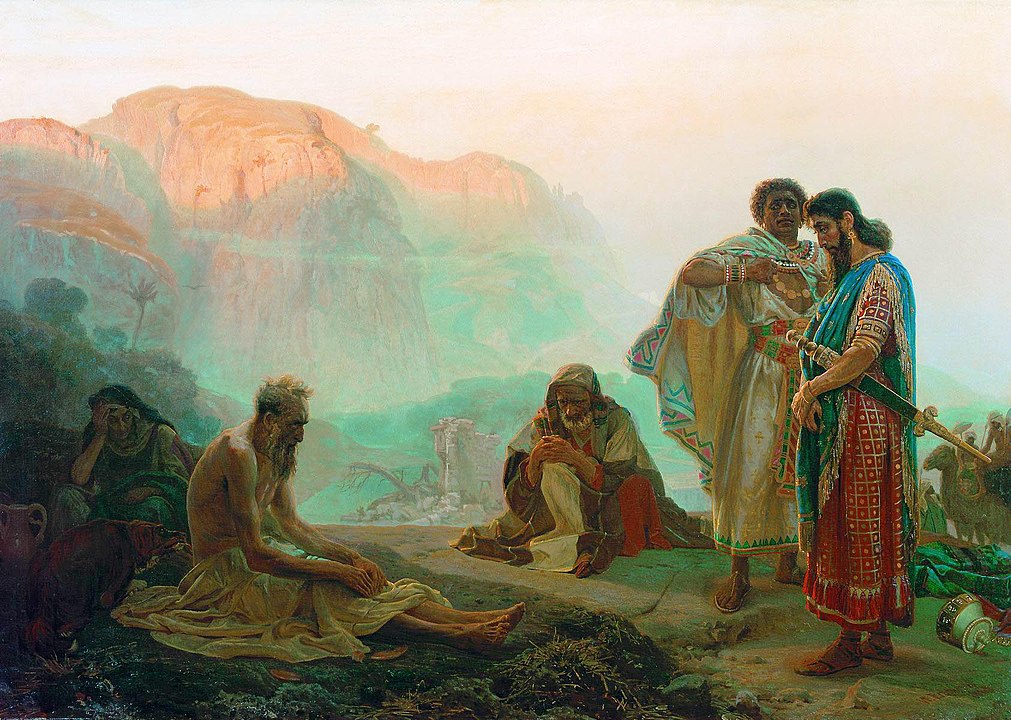
Job and His Friends by Ilya Repin (1869) – http://lj.rossia.org/users/john_petrov/854534.html, Public Domain, https://commons.wikimedia.org/w/index.php?curid=2538610

Fragments

In their synagogue was a man with an unclean spirit;
he cried out, “What have you to do with us, Jesus of Nazareth?
Have you come to destroy us?
I know who you are—the Holy One of God!”
Jesus rebuked him and said,
“Quiet! Come out of him!”

Mark 1:21-28
Look on me, O Lord of heaven,

you who break the chains of hell,
see all that is unforgiven,
all unhealed—and make me well.

Yet the very words are terror:
All unchained, what will I be?
You destroy our cherished errors;
what will you destroy in me?

I cannot but bow before you,
lord of heaven, lord of earth.
Even demons must adore you:
What am I at this rebirth?

I have fostered legions in me;
you seek undivided hearts,
yet if sin can't wholly win me,
take, at least, my better parts.

Take the fragments that have sought you,
though you shatter all that's left.
Little have I as I ought to:
Take it all, though I am cleft.

Yet, if you can, save the leavings,
though I know not what I'll be.
Take the legions I am keeping.
Change me, Lord: Let me be free.

Eleventh century fresco of the Exorcism at the Synagogue in Capernaum. By Unknown author – Scan aus: Rudolf Lehr –- Landes-Chronik Oberösterreich, Wien: Verlag Christian Brandstätter 2004 S. 79 ISBN 3-85498-331-X, Public Domain, https://commons.wikimedia.org/w/index.php?curid=6633986

Now Are the Mighty Fallen

“Alas! the glory of Israel, Saul,
slain upon your heights;
how can the warriors have fallen!
Saul and Jonathan, beloved and cherished,
separated neither in life nor in death,
swifter than eagles, stronger than lions!
Women of Israel, weep over Saul,
who clothed you in scarlet and in finery,
who decked your attire with ornaments of gold.
How can the warriors have fallen–
in the thick of the battle,
slain upon your heights!
I grieve for you, Jonathan my brother!
most dear have you been to me;
more precious have I held love for you than love for women.
How can the warriors have fallen,
the weapons of war have perished!”

2 Samuel 1:19, 23-27
Now are the embers darkened,

and dimly sinks the night;
stars fall from zenith softly,
to be swallowed by the light
that cracks the east like heartache
and seeps across the skies.
Now are the mighty fallen
to silence on the heights.

How can the day be dawning?
Morning has come too soon.
I'd swear I hear you calling—
how can you light be through?
How could there still be birdsong
when every song was for you?
Now are the mighty fallen,
and I am falling, too.

Strongest you were, and stronger
than lions in their pride,
swifter than hawks or thunder
or lightning as it dives,
gone now like any other,
fragile as every life.
Now are the mighty fallen;
blind are my weeping eyes.

Now you are gone, my brothers;
gone are the fathers, too.
Grinly now stand the mothers,
with sisters they're grieving you.
Now children rend their garments,
learning to weep too soon.
Now are the mighty fallen;
now we are fallen, too.

David Composing the Psalms, Paris Psalter, 10th century By anonymous – Paris psalter (BnF MS Grec 139), folio 1v, Public Domain, https://commons.wikimedia.org/w/index.php?curid=807679