His Mercy Yet Endures

Based on Psalm 118:

Let all the earth give thanks to God,
whose mercy yet endures.
Though for our sake it's battle-scarred,
his mercy yet endures.

For we set fire among the thorn,
but see! We were not burned.
And we set every beast aswarm:
Their stampede he has turned.

Through all that we have been and done
his mercy yet endures.
No matter how we turn and run,
he makes our steps secure.

The stone we cast out at the start
has given us its strength;
he is the keystone of our arch
and bears for us our weight.

Though we have fallen in the test,
this mercy still he gives:
The Shepherd lifts us to his breast.
We shall not die, but live.

And death itself is driv'n away—
Oh, raise the joyful shout!
This is the day the Lord has made,
who will not cast us out.

Battle of Klushino 1610 By Szymon Boguszowicz – http://www.kluszyn1610.pl, Public Domain, https://commons.wikimedia.org/w/index.php?curid=10420915

Broken

Now a week later his disciples were again inside
and Thomas was with them.
Jesus came, although the doors were locked,
and stood in their midst and said, “Peace be with you.”
Then he said to Thomas, “Put your finger here and see my hands,
and bring your hand and put it into my side,
and do not be unbelieving, but believe.”
Thomas answered and said to him, “My Lord and my God!”

John 20:19-31
We know you in the broken bread,
the wounds in hands and feet,
as one who comes here from the dead:
This is the Christ we meet.

You come to us transformed by pain:
God's only Son is marked
and bearing now the sign of Cain,
revealing God's own heart.

From timelessness you entered time;
you took our blood and breath
to bring us into life divine—
but, oh, that road is death.

We know you by the way you took;
your body is the map.
Now through the sundered veil we look
across the mortal gap.

For you have bid us peer inside 
the wounds in hands and feet.
New mercies open to our eyes,
deep calling out to deep.

And Cain, whose offering was refused,
is comforted at last,
the wheat he gave is finally used
to break the ancient fast.

For Abel has forgiven all,
whose blood spoke from the ground.
Through it we hear the Shepherd call
and know that we are found.

“The incredulity of Thomas” from an English manuscript, c.1504 By Unknown author – This image is available from the National Library of WalesYou can view this image in its original context on the NLW Catalogue, CC0, https://commons.wikimedia.org/w/index.php?curid=44920993

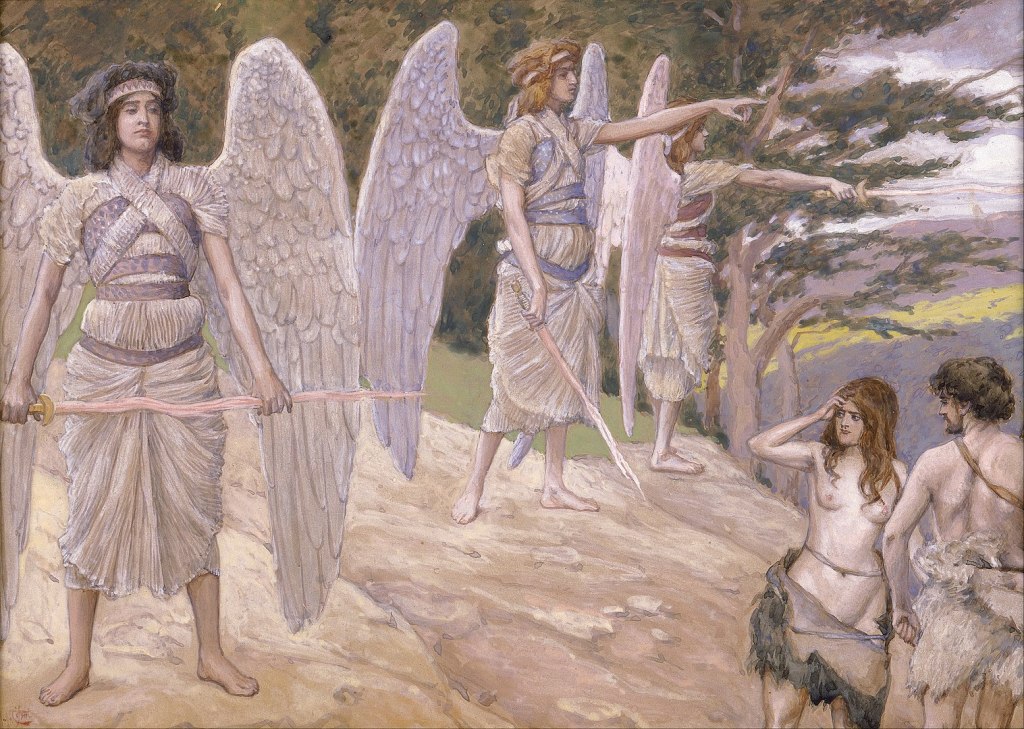
Into the Garden

Come, O Lord, into the garden
where we tasted good and ill;
come restore the heart we hardened,
wash away the blood we spilled.
When you've sunk beneath our burdens,
drunk the cup that mercy filled,
take us through the tearing curtain
to a place that's holier still.

Lead us onward from our Eden—
our beginning, not our end—
out beyond the bounds of healing,
through the wounds we seek to mend.
Past repairing to redeeming,
more than we can comprehend,
where the angels host are singing
songs we'll finally understand.

From the hell that you have harrowed,
from the weeping-watered tomb,
on the roadway straight and narrow,
through the desert now in bloom,
lead us onward through all sorrows,
past the joy we thought we knew,
to the day beyond tomorrows—
Make us there with all things new.

Expulsion from Paradise, painting by James Tissot (c. 1896–1902) By James Jacques Joseph Tissot (1836 – 1902) (French)Google Art Projectでのアーティストの詳細 – igGZ-wF6_0XnlQ at Google Cultural Institute maximum zoom level, Public Domain, https://commons.wikimedia.org/w/index.php?curid=22493007

Emmaus

And he said to them, “Oh, how foolish you are!
How slow of heart to believe all that the prophets spoke!
Was it not necessary that the Christ should suffer these things
and enter into his glory?”
Then beginning with Moses and all the prophets,
he interpreted to them what referred to him
in all the Scriptures.
As they approached the village to which they were going,
he gave the impression that he was going on farther.
But they urged him, “Stay with us,
for it is nearly evening and the day is almost over.”
So he went in to stay with them.
And it happened that, while he was with them at table,
he took bread, said the blessing,
broke it, and gave it to them.
With that their eyes were opened and they recognized him,
but he vanished from their sight.

Luke 24:13-35
When I am in the dark
and cannot see the morn,
let there be one who comes, O God,
and wakes me to the dawn.

When I have lost all heart
and taken my way home,
let there be one who can impart
new mercies and new hope.

I know I am a fool
and slow to understand;
let there be one whose word is true
to come and take my hand.

And when the road is long
and weary as the day,
let thre be one when night comes on
who says that he will stay.

Who opens my sad eyes
to joy beyond this dread.
Let there be one I recognize
in breaking of the bread.

And when I take a part,
oh, let my blind heart see.
Let there be one who lifts the dark:
Let there be Christ for me!

Supper at EmmausCaravaggio, 1606, Milan – Web Gallery of Art:   Image  Info about artwork, Public Domain, https://commons.wikimedia.org/w/index.php?curid=509489

Jerusalem, Be Joyful

Then I, John, saw a new heaven and a new earth.

The former heaven and the former earth had passed away,

and the sea was no more.

I also saw the holy city, a new Jerusalem,

coming down out of heaven from God,

prepared as a bride adorned for her husband.

I heard a loud voice from the throne saying,

“Behold, God’s dwelling is with the human race.

He will dwell with them and they will be his people

and God himself will always be with them as their God.

He will wipe every tear from their eyes,

and there shall be no more death or mourning, wailing or pain,

for the old order has passed away.”
The One who sat on the throne said,

“Behold, I make all things new.”

Revelation 21:1-5a
Jerusalem in mourning,
a widow's tale did tell,
but now in bride's adorning,
has love with her to dwell.

And he will stay forever,
her groom for all her days.
No more will they be severed,
for death has passed away.

The bridegroom in his glory
is making all things new.
He tells another story:
“Go, love as I've loved you!”

Now every king's a servant,
and all the world's a bride,
because a new commandment
the older world rewrites.

A newer earth and heaven
have sprung up in his wake,
and they will bloom wherever
we love for his love's sake.

Jerusalem, be joyful
and let him enter in:
The king of glory joins you!
The feast of love begins!
The New Jerusalem. Armenian manuscript by Malnazar and Aghap’ir in New Julfa bible, 1645. – Donabédian, Patrick (1987) (in French) Les arts arméniens, Paris: Mazenod, p. 346 ISBN: 2850880175., Public Domain, https://commons.wikimedia.org/w/index.php?curid=98280941

Noli Me Tangere

The place where I had laid you
is empty, cold, and bare.
I come again to crave you,
but will not find your there.

Not in the graveyard garden,
nor farflung Galilee—
O Christ, grant me your pardon
and come again to me!

I know that you have risen,
but where, then, is your light
when all the world is prison
and every day is night?

Come forth, O Lord of morning!
Come forth, O rising sun!
My hope, be once more dawning,
and let this night be done!

Or have you gone already
and left me in the tomb?
My earth can't be as heaven
if I am reft of you.

If you are gone, Rabbouni,
still point to me the way
and I will follow, follow
'til break of endless day.
Touch Me Not (Noli me tangere) by James Tissot – Online Collection of Brooklyn Museum; Photo: Brooklyn Museum, 2007, 00.159.335_PS2.jpg, Public Domain, https://commons.wikimedia.org/w/index.php?curid=10904788

Peter II

You said that you would serve me,
the cleansing water poured
though I could not deserve it—
but wash me now, O Lord.

While you awaited Judas,
I laid me down and slept,
but I have heard the rooster,
and bitterly I wept.

For I have failed my tempting;
my own heart I denied,
and now my nets are empty,
though I have fished all night.

You call out from the shoreline
beyond the night of grief.
I plunge into the ocean
let it wash me clean.

You ask me if I love you;
you ask it yet again.
Three times your ask it of me,
as you foretold my sin.

And three times I have answered,
and will a thousand more
through all the years advancing:
You know I love you, Lord.
RaphaelChrist’s Charge to Peter, 1515. – Victoria and Albert Museum, Public Domain, https://commons.wikimedia.org/w/index.php?curid=1718074

Peter I

When they had finished breakfast, Jesus said to Simon Peter,

“Simon, son of John, do you love me more than these?”

Simon Peter answered him, “Yes, Lord, you know that I love you.”

Jesus said to him, “Feed my lambs.”

He then said to Simon Peter a second time,

“Simon, son of John, do you love me?”

Simon Peter answered him, “Yes, Lord, you know that I love you.”

Jesus said to him, “Tend my sheep.”

Jesus said to him the third time,

“Simon, son of John, do you love me?”

Peter was distressed that Jesus had said to him a third time,

“Do you love me?” and he said to him,

“Lord, you know everything; you know that I love you.”

Jesus said to him, “Feed my sheep.

Amen, amen, I say to you, when you were younger,

you used to dress yourself and go where you wanted;

but when you grow old, you will stretch out your hands,

and someone else will dress you

and lead you where you do not want to go.”

He said this signifying by what kind of death he would glorify God.

And when he had said this, he said to him, “Follow me.”

John 21:15-19

To the tune NON DIGNUS:

O Lord, you know I love you,
though human hearts are frail.
You know how I turned from you,
when all my courage failed.

You now how I denied you;
you saw when I turned back,
but now I sit beside you—
and will you take me back?

Oh, how can you believe me?
What promise could I keep?
But somehow you receive me,
and tell me feed your sheep.

So I will be a shepherd
and all the world my field,
as I have been a fisher
for all the seas would yield.

Forever I shall follow
where you have gone before.
I am reborn from sorrow,
because you love me, Lord.
William de BrailesChrist Appears at Lake Tiberias, c. 1250. – Walters Art Museum: Home page  Info about artwork, Public Domain, https://commons.wikimedia.org/w/index.php?curid=18850975

Breath

You spoke my name, and I began;
you breathed your life into my clay,
and by that breath alone, I am:
a word you've chosen still to say.

Not mine alone, but your breaths, too,
from that first cry in Bethlehem,
in every moment make me new—
and you alone can number them.

The widow's son and Lazarus
and Jairus' daughter lost in death:
You came to them (to all of us)
and gave them back the living breath.

You breathed your last upon the cross
and first again on Easter morn.
You sobbed and screamed through helplessness
as one of us since you were born.

My panting, gasping, choking days,
my yawns and drawn-out sighs of night:
You know them all, the songs of praise
and shouting at a world not right.

So let my every breath be yours,
for you have hallowed each of them,
and breathe upon me, living Lord,
that I may have your peace in them.
Alsace, Bas-Rhin, Cathédrale Notre-Dame de Strasbourg (PA00085015). Bas-côté sud, Verrière “Résurrection du Christ” (4eBc): Jésus apparaît aux disciples By © Ralph Hammann – Wikimedia Commons – Own work, CC BY-SA 4.0, https://commons.wikimedia.org/w/index.php?curid=14571792

What Had Been Mine

Speak Mary, declaring

What you saw wayfaring:

“The Tomb of Christ, who is living.

The glory of Jesus’ Resurrection;

Bright angels attesting,

The shroud and napkin resting.

Yes, Christ my hope is arisen:

To Galilee he goes before you.”

Victimae Paschali Laudes
My love I poured upon his head
from alabaster jar,
but now my love, my lord, is dead,
and I am left in shards.

I poured my sorrows on his feet
and wiped them with my hair.
He lies there in his winding sheet,
and I am in despair.

My love is lost; my hope is fled,
but I take what I have—
despair and sorrow for the dead—
and go to life's own grave.

But where my life was laid in tomb,
he took and shook the ground.
The buried seed has burst in bloom,
and my lost love is found!

And oh! My hope himself is ris'n!
What had been mine is he:
despair and sorrow on his skin
rewritten gloriously!

And all I had, it is himself,
and all he is, is mine,
for Christ has risen up from death
and all I've lost I find.
Noli me tangere (c. 1512) by Titian – The Yorck Project (2002) 10.000 Meisterwerke der Malerei (DVD-ROM), distributed by DIRECTMEDIA Publishing GmbH. ISBN: 3936122202., Public Domain, https://commons.wikimedia.org/w/index.php?curid=159527