Eden

We have never looked on Eden—
it was gone before we woke,
but we'd swear that we have seen it
in the words our fathers spoke,
in the kindness of our mothers,
in the bread we daily break
or receive from one another:
Eden, every bite we take.

There are days when we remember
that our lives are built on sand,
walking always in the desert,
looking for the promised land.
In the daily thirst of dying
we recall those living springs;
hunger speaks of satisfying:
Eden touches everything.

Though we can't go back to Eden,
still it flavors all we do;
with the savor of your kingdom
where we find our life in you,
for the seeds in Eden planted
blossom out into a feast.
From the harvest you have granted
we will finally sit and eat.

Les très riches heures du duc de Berry, Folio 25v, By Limbourg brothers – IRHT-CNRS/Gilles Kagan – Bibliothèque du château, Public Domain, https://commons.wikimedia.org/w/index.php?curid=108858

Eden

It's not that anything is changed
between this moment and the next,
but everything is rearranged—
and with new eyes you read the text.

The overpass beneath my wheels
I dread, but dare not close my eyes.
I drive as if no image fills
my mind, of plunging from its side.

If I don't watch the needle pierce
the fragile stronghold of my skin,
I am still whole—until that glimpse.
Before I knew, there was no sin.

You'd looked on Eve a thousand times.
Day after blessèd day you'd seen
the way her hips and shoulders rhymed,
then all at once it was obscene.

Don't think about it. Just don't look.
The words are there, but I can't read—
until I can. The world's a book
and in its pages something bleeds.

Yet Eden, as it ever was,
lies all around us, full of snakes,
and all that blessed us then still does,
reaching out through paragraph breaks.

“Eve and the Serpent.” Plate from Penholm by G. Howell-Baker.- https://digital.cincinnatilibrary.org/digital/collection/p16998coll21/id/38116/rec/1, Public Domain, https://commons.wikimedia.org/w/index.php?curid=104281987

Good & Evil

The God who met us in the cool of evening
and let us see the sunlight on his face
now hides from us as first we hid in Eden,
while good and evil gladly take his place.

But surely they will save us from what's coming:
They'll not sit idle while we weep and pray
or silent stand to see our children crumbling
to fall like ashes into open graves.

But when the evening falls, bereft and empty,
the tallies of our goodness fall like leaves
for no one comes to meet us with a welcome,
and no one weeps with us in all our grief.

We weep, but still the desert's dry and thirsty—
the good we do can only do so much.
And still the serpent stings us without mercy,
reminding us of all that we have lost:

The wonder and the beauty we were given,
the home we've never known, but know its theft
because we took the only thing forbidden.
Now good and evil's all that we have left.

Not 'til one comes who knows the loss of Eden,
whose goodness is no substitute for love,
who does not turn away even from evil—
not until then will we see God with us.

The Garden of Eden in the left panel of Bosch’s The Garden of Earthly Delights By Hieronymus Bosch – This file has been extracted from another file, Public Domain, https://commons.wikimedia.org/w/index.php?curid=148816

Enemies

For Pentecost:

From the thistles east of Eden
where our sorrow soaked the ground,
where the stones cried out in grieving
Cain had struck his brother down,
we were always locked in combat,
always at each other's throats
'til a falling flame changed all that,
'til it touched us and we spoke.

From the rising heights of Babel
to the walls fo Jericho
we have lived each day a battle,
turned our swords against a foe.
'Til a rushing wind from elsewhere
whispered in our hearts a word,
'til it turned our swords to plowshares,
'til it touched us and we heard.

We are enemies and others;
we are Parthians and Medes;
we are killers of our brothers,
but the truth will make us free
when it fills us with one Spirit,
sings one song in every tongue,
when it speaks, when we can hear it,
then the Word will make us one.

Tower of Babel by M. C. EscherWoodcut, 1928. By M. C. Escher – https://arthive.com/escher/works/200099~Tower_of_Babel, PD-US, https://en.wikipedia.org/w/index.php?curid=8162683

Thistles

Cast out from our parents' garden,
poured our sweat into the soil:
Thorns and thistles for a harvest,
little for so great a toil.
Yet, O Lord, will you accept it
when we bring our sacrifice?
Will you, can you, take and bless it
if we have no greater tithe?

What you spoke at our beginning
when you took the formless world,
molded, shaped it, set it spinning,
called its dusks and dawnings good,
does that word still echo for us
though our shaping comes to naught?
Does that goodness still enfold us
if our harvest goes to rot?

Messy, naked, hungry, empty
we come from our mothers' wombs;
we will go forth in the same way
to the silence of our tombs.
Only you can fill these hands, Lord,
with the gifts you'd have us bring.
Take our nakedness and failure:
Let it be our offering.

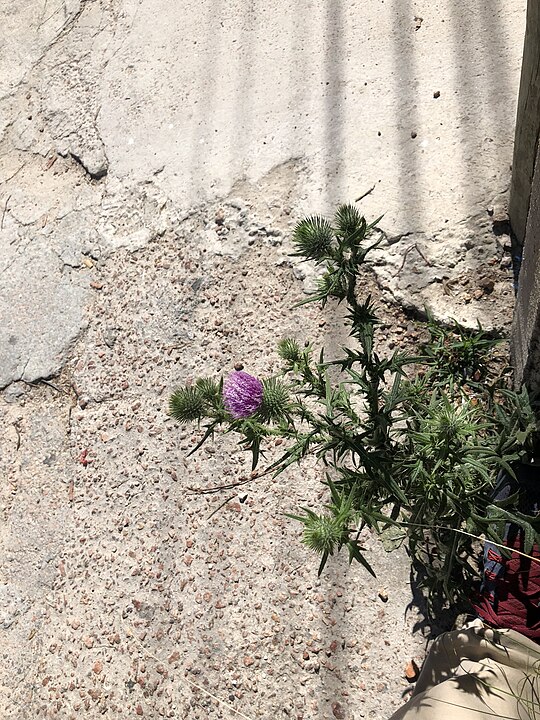
Planta de cardo en flor, en una vereda de Montevideo By Fadesga – Own work, CC BY-SA 4.0, https://commons.wikimedia.org/w/index.php?curid=144819271

Not Eden

Each night we dream of Eden
and drench our beds with tears
until dawn burgeons eastward
and morning rises clear.

Those dreams are fit for nighttime,
for we have never seen
a home but this, our exile,
where harps hang on the trees.

For this, too, is a garden,
each year by sweat renewed
until the day of harvest 
when God shall make it new.

No more the fruit of knowledge, 
but apples sweet and red
and wine and rushing water
and every bite of bread.

The harps hung on the aspens
no songs of Eden play
but notes that leave us gasping
when breeze-led branches sway.

And Christ, who walked the furrows,
shall gather in all these
and in his lasting morrow
shall make of this his feast.

Late summer dawn over the Mojave DesertCalifornia By Jessie Eastland – Own work, CC BY-SA 4.0, https://commons.wikimedia.org/w/index.php?curid=64756573

Into the Garden

Come, O Lord, into the garden
where we tasted good and ill;
come restore the heart we hardened,
wash away the blood we spilled.
When you've sunk beneath our burdens,
drunk the cup that mercy filled,
take us through the tearing curtain
to a place that's holier still.

Lead us onward from our Eden—
our beginning, not our end—
out beyond the bounds of healing,
through the wounds we seek to mend.
Past repairing to redeeming,
more than we can comprehend,
where the angels host are singing
songs we'll finally understand.

From the hell that you have harrowed,
from the weeping-watered tomb,
on the roadway straight and narrow,
through the desert now in bloom,
lead us onward through all sorrows,
past the joy we thought we knew,
to the day beyond tomorrows—
Make us there with all things new.

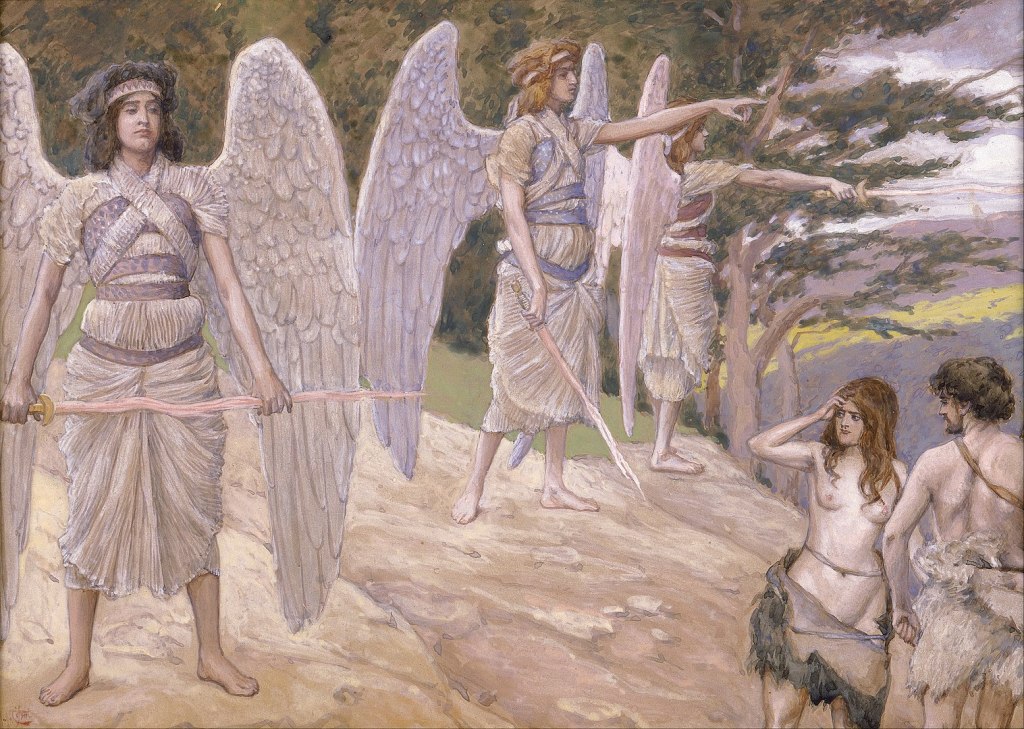
Expulsion from Paradise, painting by James Tissot (c. 1896–1902) By James Jacques Joseph Tissot (1836 – 1902) (French)Google Art Projectでのアーティストの詳細 – igGZ-wF6_0XnlQ at Google Cultural Institute maximum zoom level, Public Domain, https://commons.wikimedia.org/w/index.php?curid=22493007

When Mercy Reached From Heav’n to Earth

When mercy reached from heav'n to earth,
forgiveness stretched out east to west,
the grass that springs up from the dirt
grew to a garden of the blest.

The barren ground of Calvary
now bears an ever-blooming rose.
The gates of Eden swinging free
encompass every flow'r that grows.

And we who sprang up with the dawn
to wither in the gath'ring dusk
find that we blossom on and on,
bear fruit that overflows the husk.

How can it be that we should bear
the grain of heav'n from earthly roots
unless the vine, with tender care,
entwines itself about our shoots?

O mercy, come to soak the ground
and drench the furrows where we sleep.
The heav'nly love that you pour down
will wash and wake the fallen seeds.

O Christ the blossom, Christ the vine,
transform the grasses into trees
where all the birds their shelter find
within the living shade of peace.

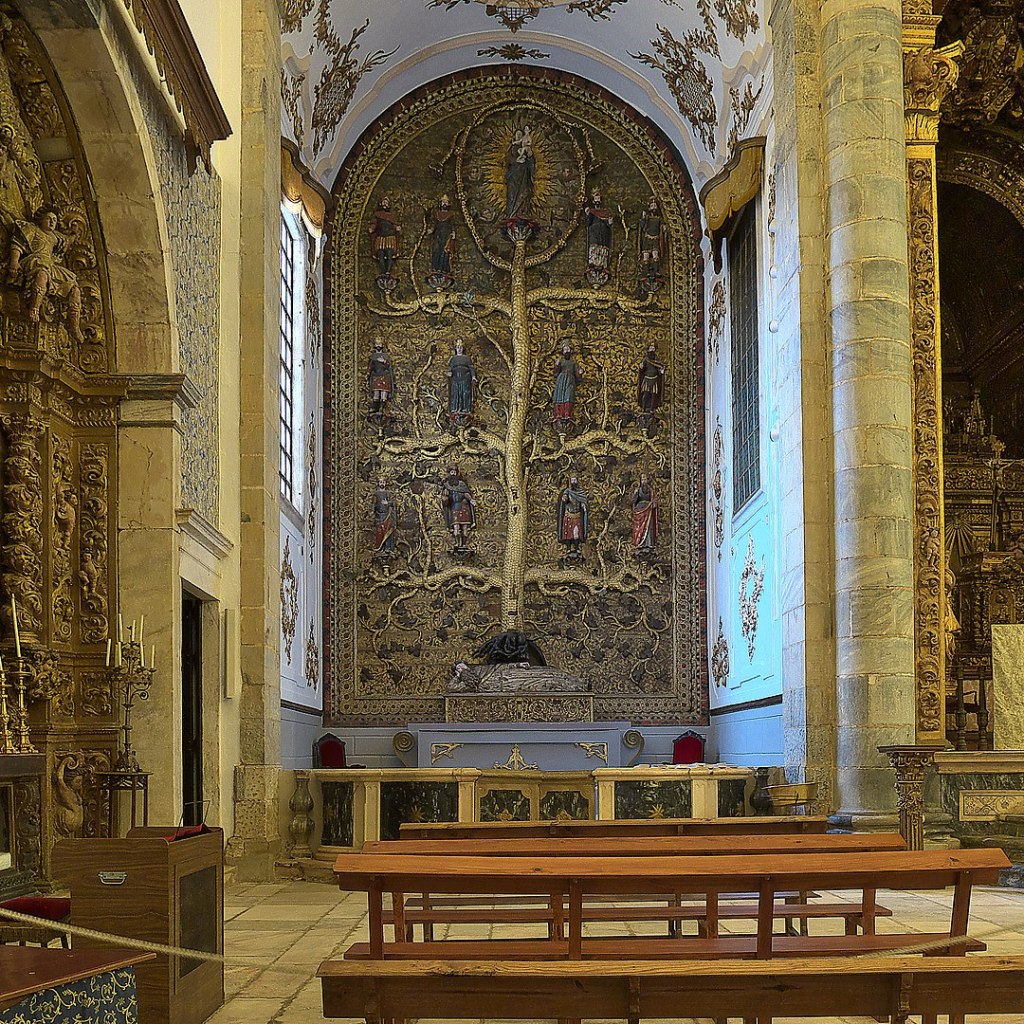
Holy church Maria of the Castle, Olivenza (Spain) By José Luis Filpo Cabana – Own work, CC BY 3.0, https://commons.wikimedia.org/w/index.php?curid=44932624

Then

An angel showed me the river of life-giving water,
sparkling like crystal, flowing from the throne of God
and of the Lamb down the middle of the street,
On either side of the river grew the tree of life
that produces fruit twelve times a year, once each month;
the leaves of the trees serve as medicine for the nations.
Nothing accursed will be found anymore.
The throne of God and of the Lamb will be in it,
and his servants will worship him.
They will look upon his face, and his name will be on their foreheads.
Night will be no more, nor will they need light from lamp or sun,
for the Lord God shall give them light,
and they shall reign forever and ever.

Revelation 22:1-7
Then all the broken promises
and all the severed ties
will be restored with all that is,
where nothing ever dies.

And all that should be but is not
shall be forevermore,
and all that was and then was lost
to us us shall be restored.

The tree of life shall grow again
in orchards, rows on rows,
and Eden's gate be opened then
to everything that grows.

The flaming sword shall plow the ground
to open every grave,
and nothing cursed shall then be found
when all has been remade.

The bodies wedded to decay
shall taste the medicine
that was in Eden locked away,
and they shall live again.

Then all the broken will be healed,
the severed mended then,
and death to endless life shall yield—
but when, my God?  But when?

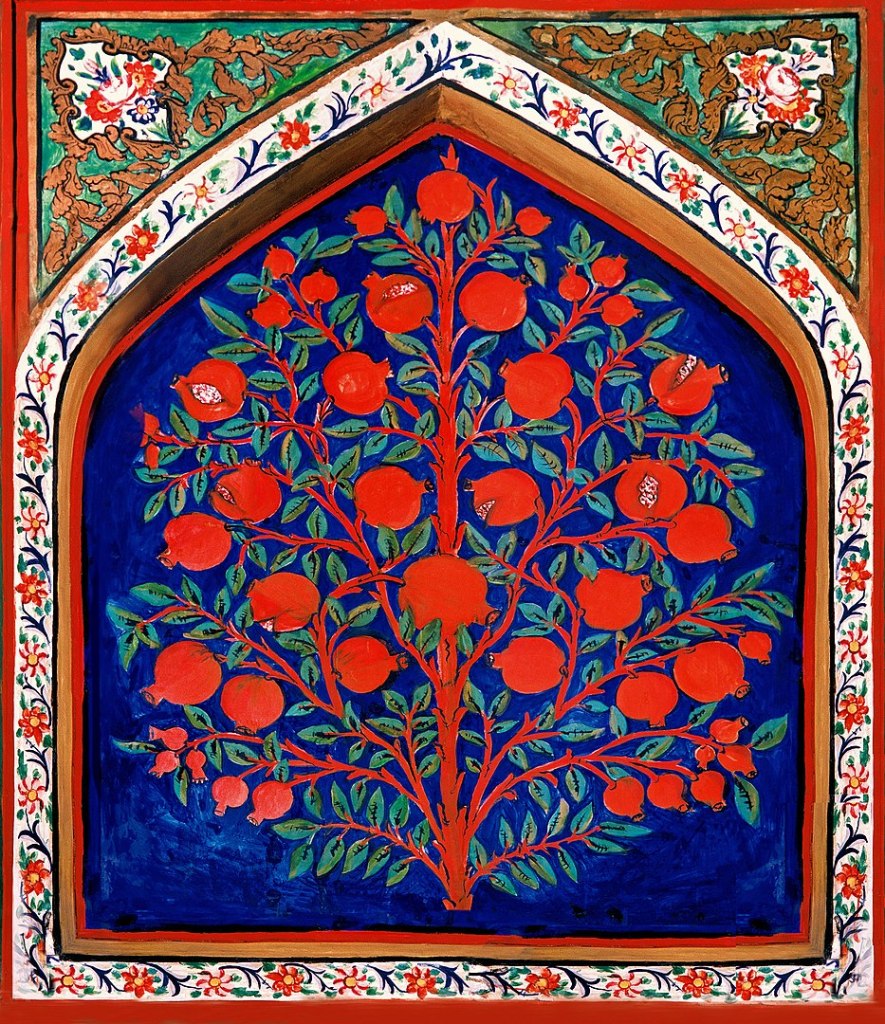
Painting of life tree in interoer of Shaki Khan palace, Azerbaijan NAtional Art Museum, Usta Gambar Garabagi By Urek Meniashvili – Own work, CC BY-SA 3.0, https://commons.wikimedia.org/w/index.php?curid=26760866

Come All, Come All

For today’s readings, to the tune KINGSFOLD (“I Heard the Voice of Jesus Say”):

There was a garden, ripe and rich
and ready to our hand,
but we, too greedy in our reach,
were from its verdure banned.
Through barren wastes we restless search,
in every grain of sand,
to find the bounty we beseech:
Oh, God, restore our land!

The God of mercy hears our cry
and ready makes the feast,
lays out the tables on the height
with seats for first and least.
“Come all! Come all!” his angels light
about our hands and feet;
we turn and rend them in reply
and fight for sand to eat.

But still the feast is ready there:
rich food and choicest wines
set in a garden more than fair,
ripe wheat and dripping vines.
Come all! This message still they bear
who bear with God's design;
if we will but his garment wear
we welcomed are to dine.

Cast off, cast off the dusty gown;
scrape off the caked-on mud,
and see a servant kneeling down
to wash our hands of blood,
to wash the feet that fin'lly found
the road that leads to good.
Come all at last where grace abounds
and feast on angels' food!
This art from the Catacomb of Priscilla in Rome may depict either the heavenly banquet or an agape feast. By Unknown author – Adapted from a picture in http://www.fortunecity.es/imaginapoder/artes/210/iconografia1.html, Public Domain, https://commons.wikimedia.org/w/index.php?curid=566562