When You Return

When you return, O God,
O brighter than our sun,
to reckon all our rights and wrong,
our done and left undone,

there at the end of time
when at your feet I stand,
oh, take the oceans of my crimes
and pour them through your hands.

The words I should not say,
the swords I should not wield,
pour in and let them drain away
through mercy's wounds unhealed.

For I am sunk in them
who cannot walk their waves.
They seep out through your innocence
'til all that's left is grace.

As deep as I have drowned,
raise me and let me stand.
The millstone ropes at last unwound,
let me rest on dry land.

And see: My sins are gone
and you alone remain.
Now fill me with the light of dawn
and make me new again!

Gospel Book, Second Coming of Christ, Walters Manuscript W.540, fol. 14v. This manuscript was executed in 1475 by a scribe identified as Aristakes, for a priest named Hakob. It contains a series of 16 images on the life of Christ preceding the text of the gospels, as well as the traditional evangelist portraits, and there are marginal illustrations throughout. The style of the miniatures, which employ brilliant colors and emphasize decorative patterns, is characteristic of manuscript production in the region around Lake Van during the 15th century. By Walters Art Museum Illuminated Manuscripts – https://www.flickr.com/photos/39699193@N03/8509826031/, CC0, https://commons.wikimedia.org/w/index.php?curid=76790938

Apple

“Do you see this woman?
When I entered your house, you did not give me water for my feet,
but she has bathed them with her tears
and wiped them with her hair.
You did not give me a kiss,
but she has not ceased kissing my feet since the time I entered.
You did not anoint my head with oil,
but she anointed my feet with ointment.
So I tell you, her many sins have been forgiven;
hence, she has shown great love.
But the one to whom little is forgiven, loves little.”
Luke 7:36-50

The righteous men refused to eat the apple—
their eyes were never opened to their sin.
They never got down in the mud to grapple
with all the filth that comes out from within.

But she has tasted, and she knows its flavor:
The skin was red and firm beneath her touch,
and it was sweet—the sweetest—so she savored,
and well she knows she is forgiven much.

Then why should she withhold the alabaster?
No, let her perfumed prayer like incense rise,
and let them stare, though none will dare to ask her
what is it draws this torrent from her eyes?

They sit at feast, yet they have tasted nothing
except their scorn to see her at his feet,
but she is sated with her Lord's anointing,
for here is something more than apples sweet

and only they who taste and they who hunger
will one day know the pleasure of that feast,
when he who came to seek them in the mud here
bows down himself to wash their dirty feet.

The Ointment of the Magdalene (Le parfum de Madeleine). James Tissot, c. 1900 – Online Collection of Brooklyn Museum; Photo: Brooklyn Museum, 2007, 00.159.214_PS2.jpg, Public Domain, https://commons.wikimedia.org/w/index.php?curid=10957535

Hunger

So they said to him,
“Sir, give us this bread always.”
Jesus said to them,
“I am the bread of life;
whoever comes to me will never hunger,
and whoever believes in me will never thirst.”
–John 6:24-35

I believe, but still I hunger;
Lord, I trust you and I thirst
as if all we have are crumbs here
in the desert of our hurt.
There are days that have no comfort,
nights when all is at its worst,
and we long for signs and wonders,
manna scattered on the dirt.

Bread of life, true bread from heaven,
every day I eat my fill
yet I wake each morning empty,
hunger crying for you still.
Let me take the bread you give me,
take the cup where mercy spills;
let it tell me of forgiveness,
that my cries shall yet be stilled.

For the bread is you, O Savior:
We will eat and we will live,
and the wine we are partaking
is your life upon our lips.
Though I rise again unsated,
let me kneel today for this:
heaven's feast of your own making
that some day shall be my bliss.

The Gathering of the Manna by James Tissothttps://thejewishmuseum.org/collection/26365-the-gathering-of-the-manna, Public Domain, https://commons.wikimedia.org/w/index.php?curid=8849141

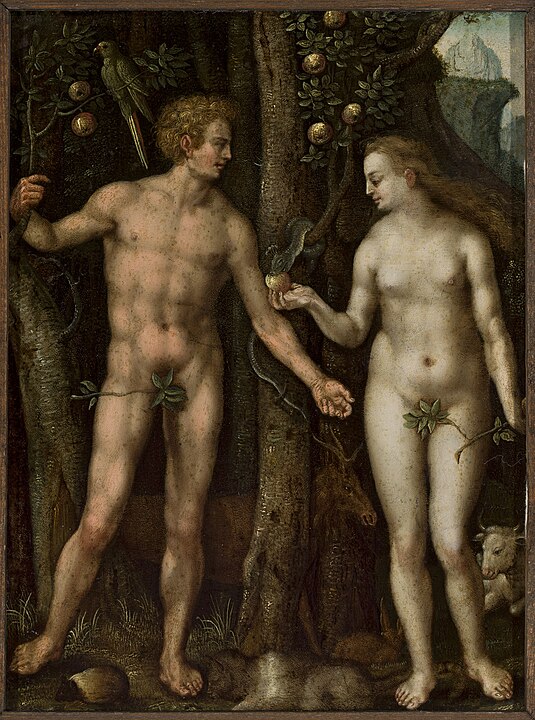
Seen

In the shadows of the garden,
I've been hiding in the leaves.
If you see, how will you pardon?
I am Adam; I am Eve.
I am Jonah bound for Tarshish,
but the sea brings no relief.
I am stiff-necked and hard-hearted,
and I'm hanging like a thief.

When you call, how can I answer?
I am naked to your sight.
Do not look at me, O Master;
do not turn on me your eyes.
I have loved the works of shadows;
I have told the world my lies.
All my making is disaster,
and I cannot bear your light.

Further to the shadows driven,
yet you call me, and I come,
and the hands that I have riven
still reach out for me with love.
Like a Father for his children,
you have mercy on our dust.
All there is is this forgiveness;
this is all there ever was.
Fall of man  Muzeum Narodowe w Warszawie ;;;fot. By After Albrecht Dürer – National Museum in Warsaw, Public Domain, https://commons.wikimedia.org/w/index.php?curid=98886658

Seven Times

Peter approached Jesus and asked him,
“Lord, if my brother sins against me,
how often must I forgive?
As many as seven times?”
Jesus answered, “I say to you, not seven times but seventy-seven times.

Matthew 18:21-35
How often, Lord, should we forgive?
Is seven times enough?
As often as we are forgiv'n 
by your unfailing love,
as often as you send our crimes
as far as east from west?
Yes, seven times and seven times
and seven times again.

For when you came to seek and save,
you fell beneath our doom,
but you bring life out from the grave
and mercy from the tomb.
Yet shall you look upon out crimes
and still forgive us then?
Yes, seven times and seven times
and seven times again.

And all that bears us down to death
from Eden to the tomb
shall fall and sink down farther yet
while we rise up with you.
Our hearts, unbound from all their crimes,
lift up a great amen!
Yes, seven times and seven times
and seven times again.

This depiction by Jan van Hemessen (c. 1556) shows the moment when the king scolds the servant. By Jan Sanders van Hemessen – http://quod.lib.umich.edu/m/musart/x-1959-sl-1.108/1959_1.108.JPG?from=index;lasttype=boolean;lastview=thumbnail;resnum=1;sel9=ic_exact;size=20;sort=relevance;start=1;subview=detail;view=entry;rgn1=ic_all;q1=hemessen, Public Domain, https://commons.wikimedia.org/w/index.php?curid=54308916

Foes

O Shepherd, set your table
in sight of all my foes;
break for us all the same bread,
as each cup overflows
with pardon for the sinner
and healing for the sick.
O, let me drink forgiveness,
and heal me where I sit.

For where you go, I follow,
but I have fallen, too—
my prayers and praises hollow,
betrayed by what I do.
You pour the cup of mercy
and let me drink it dry,
but all of us are thirsting
beneath the desert sky.

Give us the bread we ache for,
let mercy's waters flow
before we reach the shadow
where each of us must go:
the pilgrim bread unleavened,
the blessed wine we take,
and every crumb is heaven,
and every sip is grace.

Kremikovtsi Monastery fresco (15th century) depicting the Last Supper celebrated by Jesus and his disciples. The early Christians too would have celebrated this meal to commemorate Jesus’ death and subsequent resurrection. By Edal Anton Lefterov – Own work, CC BY-SA 3.0, https://commons.wikimedia.org/w/index.php?curid=15129262

The Law Is Heavy

Therefore, if you bring your gift to the altar,
and there recall that your brother
has anything against you,
leave your gift there at the altar,
go first and be reconciled with your brother,
and then come and offer your gift.
Settle with your opponent quickly while on the way to court.
Otherwise your opponent will hand you over to the judge,
and the judge will hand you over to the guard,
and you will be thrown into prison.
Amen, I say to you,
you will not be released until you have paid the last penny.

Matthew 5:17-37
The law is heavy, Lord:
I cannot bear it all
or keep it, whole in every word.
Beneath its weight I fall.

But you have borne its dread,
fulfilled its every jot,
and set before us life and death—
Choose life, for I cannot!

I am not clean within:
My brother knows my guilt;
against my sister I have sinned
and cannot pay the debt.

Forgiven I must be
and washed, as if a child.
To lay my gift before your feet,
I must be reconciled.

Come, earth and heaven's son
who bridged the great divide—
In you alone could they be one,
and so, in you, can I:

At one with earth and heav'n,
with sisters, brothers, too.
In mercy, let me be forgiv'n;
let me be whole in you.

A an etching by Jan Luyken from the Phillip Medhurst Collection of Bible illustrations housed at Belgrave Hall, Leicester, England (The Kevin Victor Freestone Bequest). Photo by Philip De Vere. https://www.flickr.com/groups/the_phillip_medhurst_collection_of_bible_prints – Own work, CC BY-SA 3.0, https://commons.wikimedia.org/w/index.php?curid=20116195

How Will It Be?

Which is easier, to say to the paralytic,
‘Your sins are forgiven,’
or to say, ‘Rise, pick up your mat and walk’?
But that you may know
that the Son of Man has authority to forgive sins on earth”
–he said to the paralytic,
“I say to you, rise, pick up your mat, and go home.”
He rose, picked up his mat at once, 
and went away in the sight of everyone.

Mark 2:1-12
How will it be when healing comes,
O Christ who came to save?
What can you do with those who jump
alive into their graves?

What, will you lift us from the earth,
or give us strength to rise?
Or spit your grace into the dirt
and smear mud on our eyes?

You'll gently tug it from our grip
when we cling to your robe,
or turn and strike us on the hip
when we will not let go.

Just drag your shadow over us,
who lie here at your feet,
or write your mercy in the dust
'til our accusers flee.

You could just say our sins are gone,
but we would lie here still
who know too well what we have done,
the measure of our guilt.

And so you say, “Get up and walk,”
to show us you forgive.
The prison doors at last unlock,
and we can rise and live.
Jesus heals the paralytic at Capernaum (Galway City Museum, Ireland) By Sheila1988 – Own work, CC BY-SA 4.0, https://commons.wikimedia.org/w/index.php?curid=88909829 WWL

You See Into My Secrets

Riffing on Psalm 32:

You see into my secrets,
forever open-eyed;
what I have buried deepest,
from you I could not hide.
You see into my failure,
my anger, and my shame;
you know the sins I cherish,
and still you call my name.

O God, I have been silent
while embers burned in me:
I have not wept or cried out,
nor set my anger free.
But you, who hear the stars sing,
hear what I do not say:
You know my heart still hard'ning,
but have not turned away.

Then, Lord, hear my confession
of sins you know full well.
O, hear and give me blessing,
though things unblessed I tell.
Put out the burning embers,
the buried bones renew
as softness I remember
and turn again to you.
The page from the Seven Pentiential Psalms for Five Voices by Simon Bar Jona Madelka. – Madelka, Simon Bar Jona; Michl, Jakub (preface) (2007). Sedm kajících žalmů pětihlasem vyzdobených. Prague: Editio Bärenreiter, Public Domain, https://commons.wikimedia.org/w/index.php?curid=5633440

Forgive

Jesus was praying in a certain place, and when he had finished,

one of his disciples said to him,

“Lord, teach us to pray just as John taught his disciples.”

He said to them, “When you pray, say:

Father, hallowed be your name,

your kingdom come.

Give us each day our daily bread

and forgive us our sins

for we ourselves forgive everyone in debt to us,

and do not subject us to the final test.”

Luke 11:1-13
Give ear unto the words
you once taught us to pray:
Forgive me all my debts, O Lord,
for I cannot repay.

My crimes have justly earned
the anger of your flames,
but listen to the pleas you've heard
for glory of your name!

Forgive me all my debts
and teach me to forgive—
and if, as well, you give me bread,
then I will eat and live.

The breath that fills my lungs;
the blood that in me moves;
your praise in every earthly tongue:
All this I owe to you

but cannot pay a cent,
nor could I ever earn
enough to buy my innocence
or make you a return.

Not if my debtors paid
and filled my hands with coins
could I afford a single day
or reason to rejoice.

Then let me cancel, too,
the trespasses I'm owed,
for all of it is first your due.
Forgive us all, O Lord.
The Lord’s Prayer, ink and watercolor by John Morgan Coaley, 1889. Library of Congress. By Coaley, John Morgan, artist – Library of CongressCatalog: https://lccn.loc.gov/2004662429Image download: https://cdn.loc.gov/service/pnp/ppmsca/23100/23124v.jpgOriginal url: https://www.loc.gov/pictures/item/2004662429/, Public Domain, https://commons.wikimedia.org/w/index.php?curid=68414975