All & Sundry

I bring my all and sundry,
O God, to worship you,
but all of me is nothing
and fades away as dew.
How can I taste these wonders
with naught to offer you?
I leave the table hungry
and hide me from your view.

For some have brought you silver,
and some have brought you gold,
a flame to smelt the impure
and melt the heart that's cold,
or notes of horns and cymbals
to stir the brave and bold,
or they have brought you simply
your own love, ages old.

But all my love is feeble
and withers ere it starts,
as all my songs are greedy,
to ply you with my art.
Yet, Lord, you love the needy,
the shattered, and the scarred:
Then shall I let you see me,
my weak and worthless heart?

So if you want it, take it
for any good you'll get.
Oh, I would give you greatness
if I had any yet.
Here I lay on your table
the little I possess:
Take what the days are breaking
and turn it to your bread.


Gold Solidus of Roman Emperor Valentinian II By Photographed by: York Museums Trust Staff – This file originated on the York Museums Trust Online Collection. YMT hosted a GLAMwiki partnership in 2013/14.This tag does not indicate the copyright status of the attached work. A normal copyright tag is still required. See Commons:Licensing., CC BY-SA 4.0, https://commons.wikimedia.org/w/index.php?curid=38984357

What Good?

When Jesus raised his eyes
and saw that a large crowd was coming to him,
he said to Philip,
“Where can we buy enough food for them to eat?”
He said this to test him,
because he himself knew what he was going to do.
Philip answered him,
“Two hundred days’ wages worth of food would not be enough
for each of them to have a little.”
One of his disciples,
Andrew, the brother of Simon Peter, said to him,
“There is a boy here who has five barley loaves and two fish;
but what good are these for so many?”
John 6:1-15

To the tune FINLANDIA:

What good is this, the little I can offer?
All I can give, O God, is just myself:
This heart fails love; this body breaks and suffers;
this mind sees not, turned inward on itself.
As nothing worth, this pittance that I proffer,
as these few loaves and fish you take and bless.

As once you took the mud that I am made of
and clothed yourself in human littleness.
You laid it out as bread for us to savor,
poured out as wine, salvation on our lips.
They were so small—five wounds that pierced two natures—
how can you feed a multitude with this?

Yet it is so, O bread come down from heaven:
You took our life and clothed yourself in dust,
yet not our sin; untainted by our leaven,
poured yourself out to fill the blessing cup
that we might drink and live and be forgiven.
Our weaknesses transformed into your love.

Then take these gifts that in my hands are nothing.
Take for your own my heart and mind and strength.
If you transform them to a wondrous something,
let it be so, for you can do all things.
Or leave me still my self as you'd begun it:
It is still good, and yours in every length.

The feeding of the five thousand; Christ blessing fishes in left background; the apostles with large baskets in foreground; illustration to William of Auvergne, ‘Postilla super Epistolas et Evangelia’, Basel; Michael Furter, 1511. 1511 Woodcut By Print made by: Urs Graf – https://www.britishmuseum.org/collection/object/P_1927-0614-125, Public Domain, https://commons.wikimedia.org/w/index.php?curid=89886988

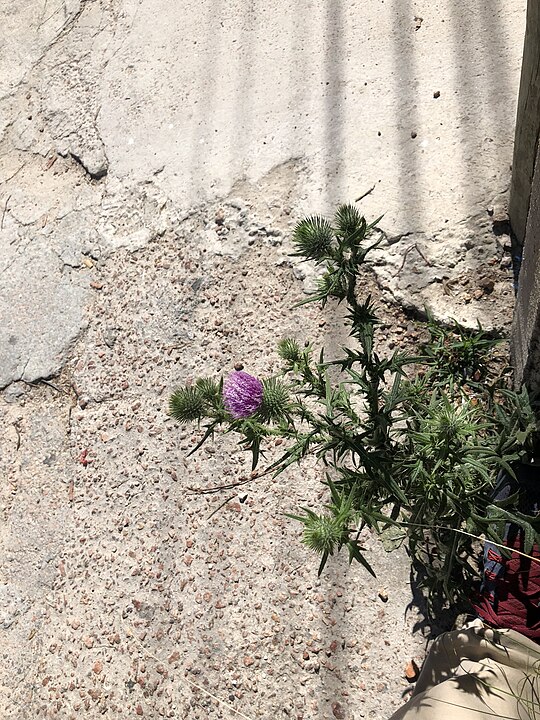
Thistles

Cast out from our parents' garden,
poured our sweat into the soil:
Thorns and thistles for a harvest,
little for so great a toil.
Yet, O Lord, will you accept it
when we bring our sacrifice?
Will you, can you, take and bless it
if we have no greater tithe?

What you spoke at our beginning
when you took the formless world,
molded, shaped it, set it spinning,
called its dusks and dawnings good,
does that word still echo for us
though our shaping comes to naught?
Does that goodness still enfold us
if our harvest goes to rot?

Messy, naked, hungry, empty
we come from our mothers' wombs;
we will go forth in the same way
to the silence of our tombs.
Only you can fill these hands, Lord,
with the gifts you'd have us bring.
Take our nakedness and failure:
Let it be our offering.

Planta de cardo en flor, en una vereda de Montevideo By Fadesga – Own work, CC BY-SA 4.0, https://commons.wikimedia.org/w/index.php?curid=144819271

I Don’t Have Flocks

I don't have flocks to offer you,
just these two turtledoves;
if they could be enough for you,
you have them with my love.

I lay no treasures at your feet,
no more than two small coins.
All that you first have given me,
I give to you again.

Little enough, the gift I bring;
I pray, let it suffice.
Though but a meagre offering,
it is my sacrifice.

If I had cities in my hold
or talents in my grasp,
or harvests ripening to gold,
you would have but to ask,

but if I have no more to give,
do not be angry, Lord.
Still let it stand for all I'd have 
if you had given more.

And let me be content with this,
with giving you my mite.
If you have made me only this,
it's good, then, in your sight.
Frescos in Ferapontov Monstery – Lesson of the widow’s mite and Healing of two blind men, Ferapontovo, Vologda Oblast, Russia By Dionisius – http://www.dionisy.com/rus/museum/120/200/index.shtml, Public Domain, https://commons.wikimedia.org/w/index.php?curid=97153736

Turtledoves

I have no kingdom to my name,
no crown upon my head,
nor can I offer pow'r or fame—
but I can give you bread.

I hold no sway in mighty lands;
no influence is mine.
Take just the labor of my hands
to work your will divine.

I have no wisdom in my soul
nor supernatural light;
no fortunes bend to my control,
but just a widow's mite.

I have no gold or frankincense,
if you would seek them here,
but take my life and take my death;
anoint them both with myrrh.

Come, take me as the offering
each moment pouring out,
for I have nothing else to bring
but all my heres and nows.

And though I have no fatted calfs,
I give you turtledoves.
I give you all I've ever have.
I give you all my loves.
Dove with an olive branchCatacombs of DomitillaRome By Dnalor 01 – Own work, CC BY-SA 3.0, https://commons.wikimedia.org/w/index.php?curid=32603350Minolta DSC